A Question or an Observation: Two Ways to Open a Chat
Choose a question or observation to open a chat with less pressure by matching your first line to the setting, the other person’s attention, and purpose.

The common mistake with a question or observation to open a chat is choosing a question just because it sounds friendly. It can make someone feel obliged to provide an answer, even when they are busy or have little to say. A useful opener fits the moment and leaves the other person room to respond—or not.
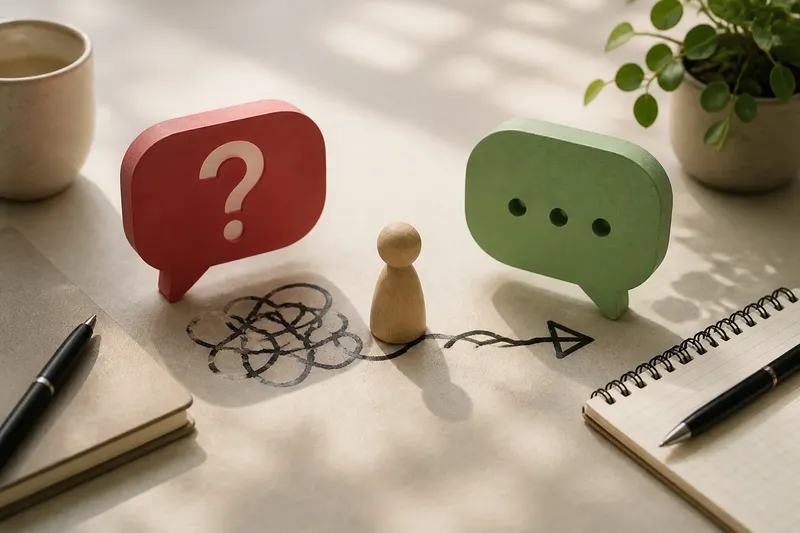
A question asks for an answer. An observation shares a detail without requiring one. Neither is automatically warmer or more polite. Consider what you need, how well you know the person, and whether they seem available before choosing.
Ask when an answer serves a clear purpose
A direct question fits when you need information or have a genuine, relevant point of interest. “Do you know which platform the train leaves from?” has a practical purpose. “Have you tried the soup here?” invites a brief opinion about something you both can see.
Keep the question within the bounds of the setting. At a neighborhood meeting, “Have you been to one of these before?” is easier to answer than “Why did you move here?” The first concerns the shared event; the second asks about personal history, which may be too much with a stranger.
Before asking, consider these checks:
- If you need a specific fact, then ask plainly; if you do not, use a shared subject or let the moment pass.
- If the person has turned toward you or continued a group discussion, then a brief question may fit; if they are focused elsewhere, wait or choose not to interrupt.
- If the question concerns a shared activity, then keep it there; if it asks for private history, choose a less personal subject instead.
- If a short answer would resolve your question, then accept it; if you expect to keep asking, reconsider whether the topic is welcome.
- If the person is wearing headphones or moving quickly, then leave them alone unless there is a practical need to speak; if they are available, ask without demanding a long reply.
- If you can accept a refusal or no answer, then the question may be low-pressure; if you would feel compelled to press, do not ask it.
A good opening question does not make someone perform. “What did you think of the speaker’s example?” offers a manageable subject. “What’s the most interesting thing about you?” asks a stranger to invent a personal introduction on demand.
Offer an observation when no answer is needed
An observation is a brief comment about an object, event, or setting you share. It can give someone several options: agree, add a thought, smile, or let the moment pass. That makes it useful when you want to connect without asking for personal information.
Keep the comment grounded in what is present. “That poster uses a surprising amount of blue” is less presumptive than “You look like someone who enjoys art.” The first leaves the other person free to respond to the poster; the second assigns them a trait they may not want to discuss.
An observation is not automatically easy to receive. Comments about appearance, behavior, or sensitive matters can put someone under scrutiny. If the detail is personal rather than shared, choose another subject or say nothing.
Match the opener to the setting and relationship
The same first line can feel natural in one place and intrusive in another. A workshop gives people a common activity. A crowded bus may not give strangers much reason to talk, even if they share the ride.
In a task-focused setting: Ask a practical question if the answer matters and the person is available. At a community garden, “Do you know where the extra gloves are?” is direct and relevant. If you have no practical need, an observation about the shared work can avoid turning a casual moment into an interview.
At a social gathering: A question about the event can invite a response; a comment about the food, room, or music gives the other person more choice. If they are already speaking with a group, relate your remark to the group’s topic rather than redirecting one person to a new subject.
In a quiet or transitional moment: Wait if someone is checking a phone, wearing headphones, or moving quickly. A polite opener still interrupts. If there is no shared reason to speak, letting the moment pass is often the considerate choice.
With someone you know: Use the form that fits your relationship and the current mood. A question can show attention to something they have chosen to discuss; an observation can share a moment without asking for an update. Familiarity does not make every personal question welcome.
Keep either opening easy to answer or leave
A question can be low-pressure when it is narrow, relevant, and easy to decline. An observation can still feel uncomfortable if it focuses on someone’s body or behavior. The useful distinction is not simply question versus comment; it is whether the person can choose how much to engage.
Compare “Is this your first time at the book swap?” with “What made you come here today?” The first concerns the event and allows a short answer. The second asks for a motive. It might suit a conversation already underway, but it can feel abrupt as an opener.
Likewise, “This room is colder than the lobby” describes a shared setting. “You look cold” makes another person’s body the topic and may invite them to explain or deny how they feel.
Say you arrive early at a pottery class and see another student looking at finished bowls. You want to start a conversation, but do not need information. You say, “The blue glaze looks different on every bowl.” They point to one and mention its color, so you respond to that detail; if they simply nod and return to looking, you leave them to it. If instead you need to know where the bowls go after class, you ask, “Do you know where we leave the finished bowls?” The first opener shares a subject, while the second seeks a specific answer.
How should you choose between a question and an observation?
Is an observation always less awkward than a question?
No. A remark about appearance or behavior can feel more personal than a simple question. Keep observations focused on something shared, such as the room, an event, or an object.
What can you say when there is no obvious shared topic?
Ask a small, honest question about the immediate situation if the answer would help, such as where a session is meeting. If you have no real question and nothing natural to comment on, you do not have to force an opening.
How can you tell if someone wants to keep talking?
Notice the response as a whole. Someone who adds detail or asks something back may be open to continuing; a short answer followed by a return to their activity is a sensible cue to stop.
Can an observation lead to a question?
Yes, if the other person takes up the shared subject or a question follows naturally. After both people comment on a chilly room, asking about a warmer seat may make sense; a polite acknowledgment alone is not an invitation to keep asking.
Do not overwork a casual opener
Memorizing witty lines or trying to make every opening lead to an engaging exchange is not worth the effort. A polished remark can sound rehearsed, while an ordinary sentence often fits the moment better. Pay attention to what is genuinely shared and whether you have a reason to ask.
For a question or observation to open a chat well, use this simple distinction: ask when an answer would help, and comment when sharing attention is enough. Keep the subject relevant, then let the other person’s response shape what happens next. The main search phrase, question or observation to open a chat, is less a formula than a choice about how much response the moment asks for.